English
Anti-Static Brush: ESD Requirements to Confirm with Suppliers
Created on 03.16
Our teams work hard to protect delicate parts. A small spark can ruin expensive hardware. That's why we use a top-notch ESD tool to clean without risks.
Finding a good vendor is more than just looking at prices. We need to check the technical specs to make sure they meet safety standards. This guide helps us ask the right questions when buying trusted cleaning gear for our workspace.
anti static brush
We aim to keep our environment clean and every circuit safe. By checking specific certifications, we can trust our purchases. Let's explore the anti-static needs we should talk about with our suppliers to safeguard our equipment.
Key Takeaways
- Confirm surface resistivity levels are within safe industry limits.
- Check for heat resistance in the fiber materials before buying.
- Verify handle conductivity to prevent dangerous charge buildup.
- Look for industry-standard safety certifications from every supplier.
- Evaluate ergonomic designs for comfortable and efficient daily use.
- Ensure the equipment effectively prevents triboelectric charging during tasks.
Understanding ESD and Why It Matters for Anti-Static Brushes
Handling sensitive electronic parts requires knowing about electrostatic discharge (ESD). ESD happens when electric current suddenly flows between two objects with different charges. This can happen through contact, an electrical short, or when a material breaks down.
ESD can seriously harm electronics and sensitive gear. It might make them malfunction, lose data, or even break completely. So, it's key to understand ESD and its effects to see why anti-static tools are so important.
What Is Electrostatic Discharge?
ESD is a big worry in places where electronics are made or handled. It happens when two objects with different charges touch or are connected by a conductor. This lets the charge balance out.
Key factors that contribute to ESD include:
- Direct contact between objects at different potentials
- Electrical short circuits
- Dielectric breakdown
The Impact of ESD on Electronics and Sensitive Equipment
ESD can really hurt electronics. It might make parts fail right away or cause hidden problems. These issues might not show up until later, when it's too late.
The consequences of ESD damage can include:
- Malfunction of electronic devices
- Data loss or corruption
- Complete destruction of sensitive components
How Anti-Static Brushes Prevent ESD Damage
Anti-static brushes help avoid ESD by safely cleaning and handling sensitive items. They're made from materials that can conduct or dissipate static electricity. This makes them safe for use.
The benefits of using anti-static brushes include:
- Prevention of static buildup during cleaning
- Safe handling of sensitive electronic components
- Reduction in the risk of ESD damage
Types of Anti Static Brush for Different Applications
Anti-static brushes come in many types, each for a specific use. They are key in industries like electronics and manufacturing. Here, static electricity can damage or disrupt work.
It's important to know the different types of anti-static brushes and their uses. This helps pick the right tool for your needs. We'll look at conductive and dissipative brushes, and those for electronics, vinyl records, and industrial use.
Conductive Brush vs. Dissipative Brush: Key Differences
Conductive and dissipative brushes are the main types of anti-static brushes. The big difference is in their resistance levels and how they handle static electricity.
Characteristics | Conductive Brush | Dissipative Brush |
Resistance Level | Low resistance (< 10^4 ohms) | Moderate resistance (10^4 to 10^9 ohms) |
Static Discharge | Rapid discharge | Controlled discharge |
Application | Sensitive electronics, high-speed static removal | General electronics, static control |
For more detailed guidance on selecting the appropriate anti-static brush, you can refer to our comprehensive guide on how to select an anti-static brush.
Anti Static Cleaning Brush for Electronics
Anti-static cleaning brushes for electronics are designed to remove dust and debris from sensitive components without causing damage. They feature soft, static-dissipative fibers to prevent the buildup of static electricity.
Employing an anti-static brush for electronics is crucial for ensuring the proper functioning of electronic components. These brushes are utilized in both the manufacturing and repair of electronic devices.
Anti Static Brush for Vinyl Records
Anti-static brushes for vinyl records help to reduce static electricity, which attracts dust and degrades sound quality. They are equipped with soft, carbon-based fibers that clean the record surface while simultaneously dissipating static.
Using an anti-static brush for vinyl records can enhance your audio experience and preserve the condition of your records by minimizing dust accumulation.
Static Control Brush for Industrial Use
Static control brushes for industrial applications are used to manage static electricity within manufacturing facilities. They are employed for cleaning equipment, removing static from products, and preventing static-related issues.
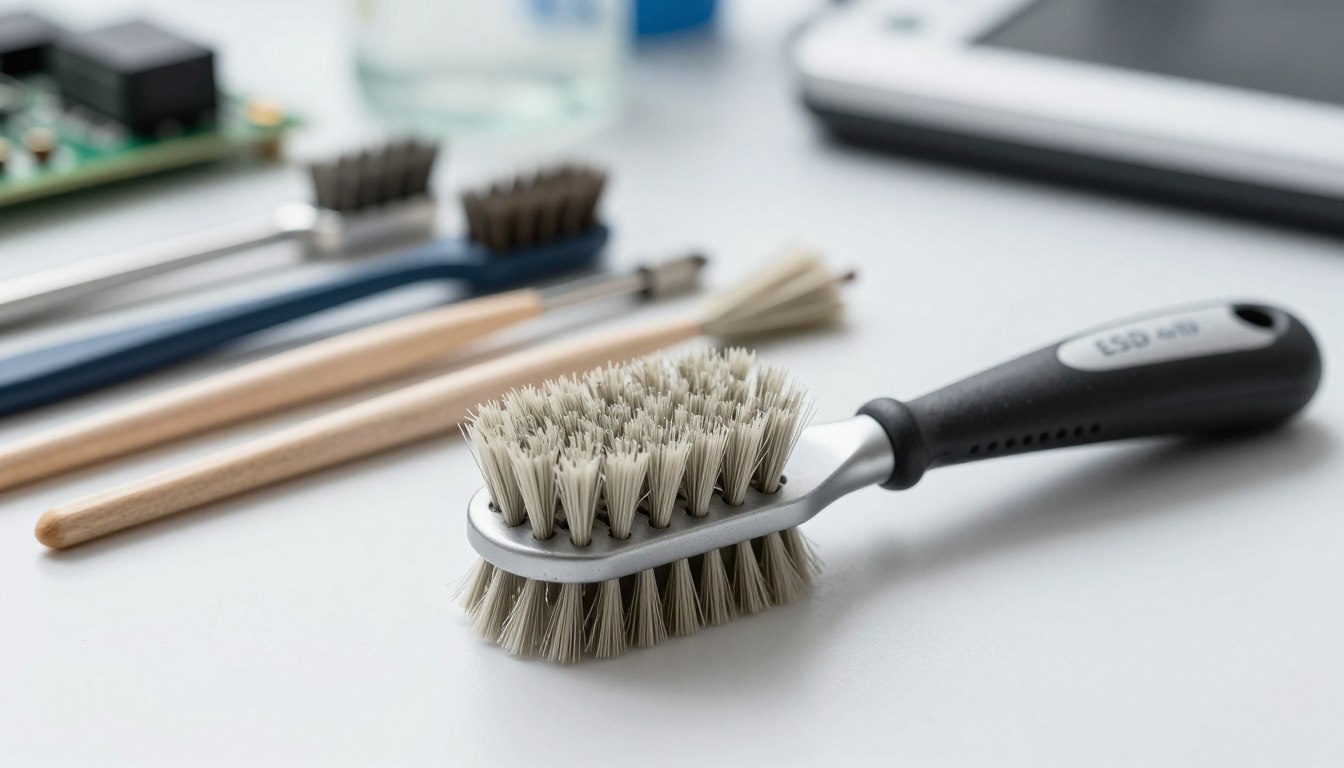
A detailed anti-static cleaning brush prominently displayed in the foreground, with soft, neutral bristles designed to effectively remove dust and debris without generating static electricity. The handle is made of durable, conductive material, showcasing its ESD compliance. In the middle ground, a variety of brushes lie organized on a clean, polished surface, highlighting different designs and sizes suitable for various applications in electronics and delicate equipment cleaning. The background features a blurred workspace with electronic components, emphasizing a professional and technical environment. The lighting is bright and even, casting subtle shadows that enhance the three-dimensionality of the brushes. The overall mood is focused and industrious, inviting the viewer to appreciate the importance of anti-static tools in maintaining equipment integrity.
In conclusion, there are many anti-static brushes for different needs. Knowing what each type does helps choose the right one for your needs.
Essential ESD Specifications to Confirm with Suppliers
To make sure your anti-static brushes work right, check some ESD specs with your suppliers. These brushes protect sensitive electronics from damage by static electricity. Their success depends on several key factors.
When looking at anti-static brushes, focus on a few important specs. These specs help the brush prevent ESD damage and last long in different conditions.
Surface Resistivity Requirements
Surface resistivity is key in how an anti-static brush deals with static electricity. It shows how well the brush resists electric current flow. A conductive brush usually has a lower resistivity than a dissipative brush.
The right choice between conductive and dissipative brushes depends on your needs. For example, in making electronics, a conductive brush with low resistivity is best for safely removing static from parts.
Material Composition and Fiber Types
The materials and fibers in an anti-static brush greatly affect its performance and life. Brushes can be made from carbon fibers, synthetic fibers, or both. The material choice impacts the brush's resistivity, durability, and cleaning power.
- Carbon fibers are great in conductive brushes because they conduct well.
- Synthetic fibers can be treated to be dissipative, perfect for controlled discharges.
Decay Time and Discharge Efficiency
The decay time and discharge efficiency of an anti-static brush demonstrate its capability to eliminate static electricity. Decay time refers to the speed at which it dissipates static, while discharge efficiency measures how effectively it transfers the electrical charge. A brush with a rapid decay time and high efficiency is optimal for preventing Electrostatic Discharge (ESD) damage.
Temperature and Humidity Performance Range
Anti-static brushes exhibit varying performance under different temperature and humidity conditions. It is crucial to ensure that the brush functions effectively within the environmental parameters of your specific application.
Certain brushes are engineered for extreme environments, making them highly suitable for industrial or outdoor applications.
ESD Standards and Certifications to Request
When selecting anti-static brushes, it is essential to verify their compliance with ESD standards. These standards serve to guarantee that the brushes perform effectively and safely in proximity to sensitive electronic components.
A close-up image of a professional anti-static ESD brush, with fine, conductive bristles arranged neatly. The brush is positioned in the foreground, showcasing its ergonomic handle and sleek design. In the middle background, soft-focus technical equipment like circuit boards and electronic components subtly hint at an ESD-safe workspace. The background is a clean, light-colored surface that enhances the focus on the brush. The lighting is bright, even, with soft shadows to create a polished, professional look. Use a macro lens angle to emphasize the texture and details of the brush. The mood is technical and professional, suitable for an article discussing ESD standards and certifications.
ANSI/ESD S20.20 Compliance
Look for ANSI/ESD S20.20 compliance. This standard sets the rules for ESD control programs. It makes sure anti-static brushes won't harm sensitive electronics. Suppliers who follow this standard show they care about quality and ESD safety. For more info, visit this page.
IEC 61340 Standards
IEC 61340 standards are also crucial. They cover ESD control, including protective materials and equipment. If your static control brush meets these standards, it's proven to prevent electrostatic discharge.
MIL-STD Specifications
For the military and aerospace, MIL-STD specifications are needed. These specs are tough, ensuring anti-static brushes can handle harsh conditions. Following MIL-STD means your ESD brush is ready for tough jobs.
Third-Party Testing and Certification Documents
Don't forget to ask for third-party testing and certification documents. These prove a product's quality and ESD compliance. Checking these documents helps you trust your anti-static brushes.
Critical Questions to Ask Your Electrostatic Discharge Brush Supplier
Choosing the right anti-static brush starts with the right questions. It's important to know if the supplier meets ESD standards. We need to understand their testing methods, quality control, and product consistency.
Testing Methods and Quality Control Procedures
Ask your supplier about their testing methods for ESD brushes. This includes their quality control steps, like:
- Regular checks on materials and finished products
- Calibrated equipment for testing
- Training for staff on ESD-sensitive components
Knowing these steps helps us see if the supplier is serious about quality.
Batch Testing and Traceability Documentation
Batch testing is key to ensure every brush meets standards. Ask about their batch testing and traceability documents. This includes:
- Details on testing parameters and criteria
- Documentation tracing the product to raw materials
- Certification for ESD compliance
Warranty and Performance Guarantees
A good supplier offers warranties and performance guarantees. Ask about warranty duration, coverage, and conditions. Also, ask about performance guarantees, like brush lifespan and environmental performance.
Maintenance and Lifespan Expectations
Lastly, ask about maintenance and lifespan of the brush. This helps with planning and budgeting. Ask for maintenance tips, replacement frequency, and lifespan factors. This info optimizes brush use and future planning.
Conclusion
Choosing the right anti-static brush is key to keeping sensitive equipment safe from static damage. Knowing the different types, like static control brushes, is important. Also, make sure to check the ESD specs and certifications from suppliers.
We've talked about why ESD compliance matters, the uses of anti-static brushes, and what to ask suppliers. This guide helps you find the right brushes for your needs. It will improve your work.
When looking for an anti-static brush, check for ESD standards and certifications. Look for ANSI/ESD S20.20 compliance to meet industry standards. This step helps protect your equipment and keeps your work running smoothly.
FAQ
What is the primary difference between a conductive brush and a dissipative brush?
The main difference lies in their electrical resistance. Conductive brushes have low resistance, allowing electrons to flow easily to the ground. This is great for quick discharge but needs careful grounding.
Dissipative brushes, on the other hand, have higher resistance. They move charges more slowly and in a controlled way. We usually recommend dissipative brushes for sensitive microchips to avoid sudden surges.
Why can't we just use a regular cleaning brush for our circuit boards?
Regular nylon brushes can generate thousands of volts of static electricity through friction. An antistatic brush for electronics is made with materials like carbon fiber or treated natural bristles. These materials prevent triboelectric charging.
Using a high-quality ESD brush ensures we remove dust and debris without causing damage. This is crucial for keeping semiconductors and motherboards safe.
Which ESD standards should we verify with our suppliers?
To protect your electronics, check if your electrostatic discharge brush meets ANSI/ESD S20.20 or IEC 61340 standards. For military projects, MIL-STD compliance is necessary. Suppliers like Desco Industries or SCS provide testing documents for surface resistivity and decay time.
Does an anti-static brush for vinyl records work the same way as an industrial one?
While similar, an anti-static brush for vinyl records is designed to be gentle. It's made for delicate PVC grooves and neutralizes static electricity that attracts dust. Brands like Audio-Technica or Boundless Audio use ultra-fine carbon fiber bristles.
These bristles reach deep into the grooves to discharge the record. This ensures your stylus doesn't pick up "pops" and "clicks" from static-clinging debris.
How does humidity affect the performance of our anti static cleaning brush?
Static is a bigger problem in dry environments. Always check the performance range of your anti static brush regarding temperature and humidity. Some brushes need moisture in the air to dissipate charges.
Others, with high carbon content, work well even in low-humidity cleanrooms. Knowing these specs helps us choose the right brush for our workspace climate.
What questions should we ask a supplier about their quality control procedures?
When vetting a supplier, ask about batch testing and traceability. Ask if they provide a certificate of conformance for each lot. Also, inquire about the testing methods for discharge efficiency.
It's also important to ask about the brush's lifespan and maintenance. The conductive properties can degrade if the bristles get contaminated with oils or flux residues.
How long does a typical ESD brush last before it needs replacement?
The lifespan of an ESD brush depends on use frequency and environment. In high-volume assembly lines, we might replace them every few months. For occasional use, they can last years.
The key is to regularly test the surface resistivity. If the bristles can't dissipate charges effectively, it's time for a replacement to protect our electronics.
Contact
Leave your information and we will contact you.


